
Reasons for having this policy
We recognise that the welfare of all children, young people and adults at risk, is paramount and that all have equal rights of protection. We have a duty of care when they are in our charge, and we will do everything we can to provide a safe and caring environment whilst they attend our activities. Additionally, no one should come to any harm through their contact with our organisation and, as part of that commitment, we do everything we can to ensure everyone feels safe and protected from any form of harm, abuse and neglect regardless of their role.
MRN’s Child and Vulnerable Adults Safeguarding Policy establishes a framework to support employee, volunteer and management representatives in their practices and clarifies the organisation’s expectations. It outlines how the organisation undertakes its responsibilities with regard to protection of children and/or vulnerable adults and how it will appropriately respond to concerns.
The policy describes:
• The potential risks – who may pose a risk and the situations that may increase risk.
• Checking people who work or volunteer for the organisation.
• How people can raise concerns.
• How MRN responds to concerns or allegations of harm.
• Raising awareness for staff and volunteers.
Definitions
There is no single law that defines the age of a child across the UK. A child is someone under the age of 18 or under the age of 16 in Scotland ( In Scotland, whilst child protection procedures may be considered for a person up to the age of 18, the legal boundaries of childhood and adulthood are variously defined. )
There is no single law that defines an adult at risk across the UK. An adult at risk is a person over the age of 18 years (16 in Scotland) and is:
- having needs for care and support, and
- experiencing, or is at risk of, abuse and neglect and
- as a result of those care needs, is unable to protect themselves from either the risk of, or the experience of abuse or neglect.
Safeguarding – embedding practices throughout the organisation to ensure the protection of children and/or vulnerable adults wherever possible.
Protection – responding to circumstances that arise.
Designated Safeguarding Officer
The CEO is responsible for ensuring this policy is implemented.
The CEO will be appointed as a Designated Safeguarding Officer (DSO) to oversee the implementation of this policy and with whom any staff members can raise any concerns.
The Deputy Designated Safeguarding Officer (DDSO) will oversee the complaint if it has been raised against the CEO.
Personnel checks + recruitment
All MRN staff, paid or voluntary, who work with children and/or vulnerable adults through MRN’s activities, need to be safe to do so in child/vulnerable adult’s protection terms. To ensure this, MRN will ensure the following:
- We seek to value, listen to and respect vulnerable people in all our projects. All staff and volunteers sign MRN’s code of conduct
- Checks are carried out on all prospective senior management , staff and volunteers who will be/are working with children and/or vulnerable adults:
- criminal records check at a level relevant to the role and activities;
- Personal referee, nominated by the applicant – a person not related to the applicant and can attest to the applicant’s character, trustworthiness and any previous experience of working with/looking after children and young people.
- Proof of identity or other appropriate photographic identity, and of residence
- At all times the onus is on the applicant/employee/volunteer to reveal any conviction, caution, bind-over, probation order, or pending prosecution, whether imposed prior to or within the period the applicant works on project activities.
- Job descriptions for all roles involving contact with children and/or vulnerable adults will contain reference to safeguarding responsibilities. Recruitment adverts or application details will include the following safeguarding statement:
“recruitment is undertaken in line with safe recruitment practices.‟
Application forms will require applicants to sign consent for checks to be made and the DSO will be responsible for conducting the enquiries ensuring the confidential and security of records and will maintain a confidential file on each applicant including the following:
- copies of all forms, consents and replies;
- A log of all other non-written communication that is relevant will be recorded
- The file of an unsuccessful applicant,or a successful applicant who declines the post, will be kept for six months and then safely destroyed by the DSO. This period will be increased to 12 months from the date of leaving the project’s service for any successful applicant who commences work with the project.
- Existing staff (paid or unpaid) who transfer from a role which does not require a DBS check to one which involves contact with children/vulnerable adults will be subject to a DBS check.
Consultants, sub-contractors and partner organisations commissioned to work for MRN and working with children/vulnerable adults will also be required to show they meet MRN’s safeguarding requirements, including DBS checks. They are expected to follow our Code of conduct and Ethical data collection practices, including to record and store information professionally and securely.
In line with data protection law, everyone has the right to inspect their own confidential records and may do so on request to the DSO. The DSO may only withhold such agreement and access if to do so might jeopardise a project or police or social services investigation relating to child protection matters or might lead to a child’s welfare and safety being compromised.
Induction + training
MRN shall ensure that there is adequate and appropriate induction and ongoing training and information to all, as required employed staff and voluntary workers concerning safeguarding matters, which shall be the responsibility of the Chief Executive to devise and implement. All employees and voluntary workers shall have this policy drawn to their attention on joining the project and it shall be the duty of the Chief Executive and line managers, to ensure that such persons are fully aware of how and where to access the full policy statement, and that the DSO is the person through whom they should route queries concerning the policy.
MRN is committed to a trauma-informed approach in how it engages and works with vulnerable people. Staff and volunteers are offered training on how to undertake this approach, especially in undertaking research, interviews, and other interactions.
Recognising Abuse in Children Young People and Adults at Risk
The following list is for guidance only. It is important to be observant, listen to what is being said and record. e.g. is what you are observing and being told about an injury consistent with the injury?
- Abuse related to faith or belief
- Alcohol and Substance misuse
- Bullying, harassment and sexual harassment
- Breast Ironing
- Carrying offensive weapons
- Child criminal and sexual exploitation including County Lines
- Child on child abuse, including sexual violence and upskirting
- Concealed pregnancy
- Criminal exploitation
- Discriminatory
- Domestic abuse, including “honour” based abuse
- Emotional
- Exploitive use of technology
- Female Genital Mutilation (FGM)
- Financially Motivated Sexual Extortion(FMSE)
- Financial or material abuse
- Forced marriage
- Gangs
- Gambling
- Hate and “mate” crime
- Hazing and initiation rites
- Hoarding
- Modern slavery
- Neglect and acts of omission
- Online safety
- Organisational or institutional
- Psychological
- Physical
- Radicalisation
- Self-neglect
- Sexual
- Trafficking
Handling Disclosures
When a disclosure is made by a child, young person or adult at risk it is important to remember to:
- take what you are being told seriously
- stay calm and reassure
- do not investigate
- do not delay
and always
- seek advice from the DSO or DDSO
- make a careful recording of anything you are told or observe, date and sign.
A disclosure may come from someone telling you:
- they have or are being abused
- they have concerns about someone else
- they are themselves abusing or likely to abuse someone else
SAFEGUARDING PROCESS
STEP 1
- Take whatever action is required to ensure the immediate safety or medical welfare of the individual
- Remain calm and non-judgmental
- Do not discourage from disclosure
- Use active listening skills and remain sympathetic and attentive
- Give reassurance but do not press for more detail or make promises
STEP 2
- Explain that you cannot keep information about alleged or suspected abuse confidential
- Clarify main facts, summarise what has been said to you
- Remain sensitive
- Explain that the designated safeguarding officer must be informed
- Seek the person’s consent to share this information
- Consider issues of capacity, consent, best interest and public protection
- Offer future support from yourself or others (designated safeguarding officer)
STEP 3
- Take all reasonable steps to ensure that the individual is in no immediate danger of further harm
- Preserve evidence
- Record all the information gathered in the incident report form (template 1), store and send securely to the DSO or DDSO
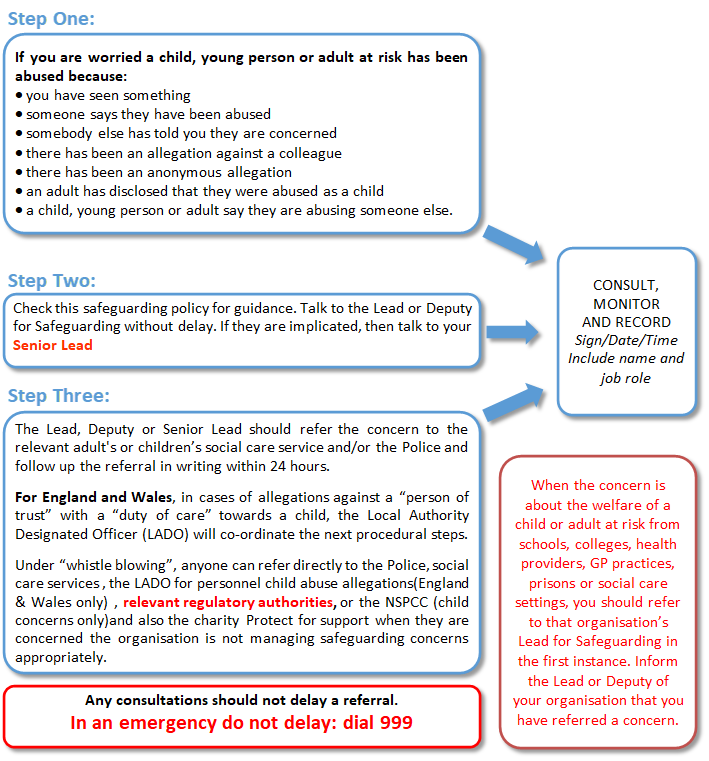
Handling Allegations / Dealing with Complaints
Any suspicion, incident, allegation or other manifestation relating to child/vulnerable adult protection should be reported to a manager and/or the DSO. The reporting member of staff will make a verbal report but should also make a written report outlining in adequate detail what was heard, seen, reported, alleged etc. The member of staff will sign and date the written report. If more than one worker observes the same incident, a separate report is to be made by each worker. The DSO will keep records in such a way to enable appropriate cross-referencing of reports.
The DSO, who is the CEO, or the DDSO will decide whether the matter can be dealt with internally or whether it is of such seriousness (e.g. a criminal offence has occurred) that the appropriate authorities need to be informed.
Reporting and dealing with allegations against members of staff
Any member of staff (paid or unpaid) is required to report any concerns about a colleague to the DSO or if the complaint is against the CEO to the DDSO. The DSO or DDSO should inform the person against whom an allegation has been made as soon as possible unless there appears to be a case that this might prejudice a criminal investigation.
Where the complaint is against a member of staff
The DSO will also consider whether suspension of the worker is advisable whilst the allegation is being investigated. The DSO will gather as much detail from available sources as possible, by way of investigation. The DSO will notify the Chair of trustees. They will recommend whether the circumstances constitute grounds either:
- to treat the matter as a disciplinary issue, either as misconduct or gross misconduct, with associated rights of appeal; or
- to dismiss the allegations as unfounded, or to make such other non-disciplinary recommendations as are appropriate.
The person against whom such non-criminal allegations are made should have an opportunity to give an explanation or answer to any allegation at an interview conducted by and minuted by the DSO, as they are also a CEO.
If a criminal allegation is made e.g. of sexual abuse and impropriety, or physical assault, or inappropriate behaviour, the CEO will suspend the person from any activity in the project under the heading of alleged Gross Misconduct. If it is warranted, this may be without pay, should the evidence appear strong enough to justify the matter. The matter will be reported immediately to the police.
Where the complaint is against the CEO
The DDSO will consider whether suspension of the CEO is advisable whilst the allegation is being investigated. The DDSO will gather as much detail from available sources as possible, by way of investigation. The DDSO will notify the Chair of trustees. They will recommend whether the circumstances constitute grounds either:
- to treat the matter as a disciplinary issue, either as misconduct or gross misconduct, with associated rights of appeal; or
- to dismiss the allegations as unfounded, or to make such other non-disciplinary recommendations as are appropriate.
The person against whom such non-criminal allegations are made should have an opportunity to give an explanation or answer to any allegation at an interview conducted by and minuted by the DDSO.
If a criminal allegation is made e.g. of sexual abuse and impropriety, or physical assault, or inappropriate behaviour, the Chair of Trustees will suspend the person from any activity in the organisation under the heading of alleged Gross Misconduct. If it is warranted, this may be without pay, should the evidence appear strong enough to justify the matter. The matter will be reported immediately to the police.
Disciplinary action
Employees who do not conform to MRN’s child and vulnerable adult protection policy could face disciplinary action up to and including dismissal.
Record Keeping
At all times when required, and especially where there is a safeguarding concern, we are committed to keeping records which are:
- recorded on a safeguarding incident form
- of sufficient details of child, young person or adult at risk to identify individual who is subject of concern and any significant others
- accurate and factual/based on fact, as a true record of:
- what has been monitored/observed
- what has been said and by whom
- what has given cause for concern
- what action has and/or will be taken including the reason for those actions
- the reason stated for no action being taken and by whom
- non judgmental
- timely within 24 hours
- signed, timed and dated by the writer and co- signed by the DSO or DDSO
- shared as appropriate by the DSO or DDSO
- stored safely and securely by the DSO or DDSO
Bullying, Harassment and Sexual Harassment
Bullying, harassment and sexual harassment can take many forms and include:
- physical violence including threats, verbal assaults and taunts, the destruction of property, extortion, unwanted sexual interest or contact
- indirect forms of bullying including ignoring a person and the withdrawal of friendship, malicious gossip and spreading rumours, abusive or oppressive graffiti, the use of social media, electronic messages and websites.
- motivation of prejudice against certain groups for example on the grounds of race, religion, gender and disability
Whether directed at children, young people, adults at risk, staff, volunteers, parent and carers, bullying, harassment and sexual harassment, physical, sexual and/or emotional abuse will not be tolerated. All such behaviour will be treated as a safeguarding concern when aimed at children, young people and or adults at risk. If children, young people and/or adults at risk are engaging in bullying, harassment or sexual harassment it is also a safeguarding concern and should be reported to the DSO or DDSO.
We will:
- provide a culture of equality and respect for all with zero tolerance to any form of bullying, harassment and sexual harassment
- report all incidents of bullying, harassment and sexual harassment observed or disclosed, to the DSO or DDSO who will take the appropriate action
- take immediate steps to stop the behaviour and mitigate the effects of bullying, harassment and sexual harassment
- record all incidents with observations and witness statements, and action taken, signed, timed and dated
Online Safety
Why do we need to include Online Safety?
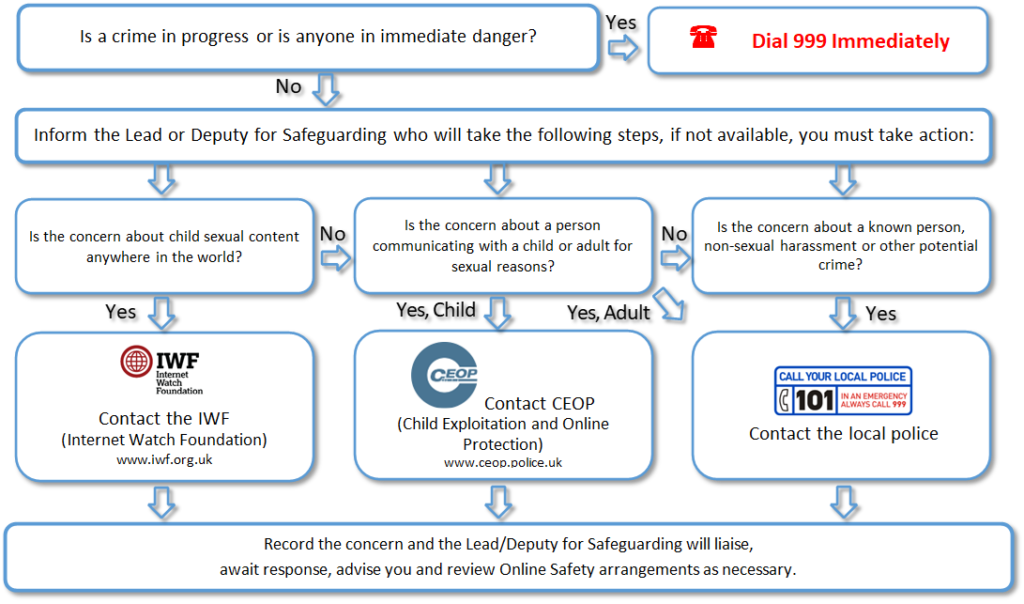
Modern digital technology has made access to information and communication increasingly easy for everyone. This is especially so for those who cannot always go out to socialise and rely on websites for social networking, watching films, downloading music, buying lottery tickets, shopping etc. Government guidance is clear, that all organisations working with children, young people adults at risk, families, parents and carers have responsibilities. It is also important to remember, children, young people and adults at risk can also abuse and such incidents fall into the remit of this policy
Online Safety Code of Conduct:
We expect everyone in our organisation to agree and sign up to our Online Safety code of conduct to:
- use the internet and other forms of communication in a sensible and polite way.
- only access websites, send messages or access and use other resources that will not hurt or upset anybody.
- seek permission if they want to use personal information or take photographs of other people.
- report any concerns to the DSO or DDSO
- not maintain confidentiality if there is a concern about the welfare of a child, young person or adult at risk.
What are the Risks?
There are many potential risks including:
- inappropriate relationships or prostitution.
- accessing inappropriate or illegal websites.
- receiving unwanted or upsetting texts, e-mail messages or images.
- being “groomed” by another with a view to meeting the child, young person or adult at risk for their own illegal purposes including sex, drugs or crime.
- sharing nudes or semi nudes.
- viewing or sending unacceptable material such as inciting hatred or violence.
- sending bullying messages or posting malicious details about others.
- ignoring copyright law by downloading e.g. music, videos, homework cheat materials etc.
- overspending on shopping and gambling sites.
- being at risk of identity fraud for money transactions.
What else might be of concern?
A child, young person or adult at risk who:
- is becoming secretive about where they are going to or who they are meeting.
- will not let you see what they are accessing online.
- is using a webcam in a closed area, away from other people.
- is accessing the web or using a mobile for long periods and at all hours
- clears the computer history every time they use it.
- receives unexpected money or gifts from people you don’t know.
- does not appear to have the money they should have.
A person who:
- befriends a child, young person or adult at risk on the internet or by text messaging.
- has links to children, young people and/or adults at risk on their social media pages
- is secretive about what they are doing and who they are meeting.
Social media
The Online Safety Act 2023 and associated government guidance A Guide to the Online Safety Bill now makes social media companies more responsible for their users’ safety on their platforms. This means children and adults will be protected online by making social media platforms:
- remove illegal content quickly or prevent it from appearing in the first place. This includes removing content promoting self-harm
- prevent children from accessing harmful and age-inappropriate content
- enforce age limits and age-checking measures
- ensure the risks and dangers posed to children on the largest social media platforms are more transparent, including by publishing risk assessments
- provide parents and children with clear and accessible ways to report problems online when they do arise
Such content should be reported to the service provider and if they do not respond appropriately the matter can be reported to Ofcom.
IT IS IMPORTANT TO FOLLOW THE STEPS BELOW FIRST WHENEVER ANYONE IS AT RISK OF HARM
Safeguarding Practical Guidance
Photography & Filming Guidance
Both still and moving images are key to recording the successes and achievements of children, young people and adults at risk in their lives and activities. However, it is vital to remember that images (especially digital images) can be used, shared, stored and/or distributed inappropriately, and that their storage and use must comply with the UK GDPR.
It is therefore important to be clear about:
- explaining to parents and carers why caution is necessary
- the purpose of images e.g. parent’s and carer’s own record, media and publicity etc
- the content required when using a professional photographer
- informing parents and seeking their consent for any publication or media use
- publishing only necessary identifying details alongside individual’s photos in newspapers, websites etc
- taking photographs openly and away from sensitive areas (changing rooms, toilets, etc)
- the suitability of clothing e.g. swimsuits
- any group photos being taken only during the activity or on the premises
- all those taking photos signing a registration form, which also identifies the purpose and use of any images
- ensuring secure storage of all images
- identifying how long unused images will be retained
- identifying how long copies of published images will be retained
The above guidance applies to all still and moving images, however they are created (mobile phone, still camera, video camera etc). The type of equipment and the equipment’s owner should also be recorded on the registration form.
Activities, Events and Visiting Speakers/Activity Leaders
We will always ensure visitors and activities undertaken are risk assessed and we are committed to:
- ensuring that those who run activities have the expertise, knowledge and skills to do so properly
- completing a risk assessment which involves identifying risks and the means of reducing or eliminating those risks for all activities or events
- risk assessing any changes being made to activities or events involving children, young people and adults at risk
- having a written plan in place if the event or activity has to be cancelled
- having a written plan in place in case of emergency including contact numbers
- implementing the required actions identified by the risk assessment process and reviewing the effectiveness of these on a regular basis
Buildings and Venues
Safeguarding risk assessments will be carried out on all building and venues used by our organisation or by the host’s venue management.
The safeguarding risk assessment should cover:
- access especially how people enter and leave the building
- signing in protocol
- use of keys
- toilets and changing rooms
- any outside space
- car parks
- any other relevant issues
What do I do if I am concerned?
If you have any concerns, speak to the DSO or DDSO
Remember:
- do not delay.
- do not investigate.
- seek advice from the DSO or DDSO
- make careful recording of anything you observe or are told
Review of this policy
| This policy was agreed on 24 March 2026 by the board of directors/ trustees and will be disseminated in a timely manner. This policy will be reviewed and updated annually or when there are substantial organisational or legislation/best practice changes. | |||
| The policy should be signed by all those who lead or deputise for safeguarding so edit names of these roles accordingly to suit your organisation. | |||
| Signature | Name | Date | |
| Designated Safeguarding Officer (DSO) | Fizza Qureshi | 26 March 2026 | |
| Deputy Designated Safeguarding Officer (DDSO) | Joanna Knight | 26 March 2026 | |
| Scheduled date for next review: | 24 March 2027 | ||
Safeguarding incident report forms
Please use the following templates to record and report an incident or disclosure. Please send it to the Designated Safeguarding Officer (DSO) or the Deputy Designated Safeguarding Officer (DDSO) as appropriate.
- Designated Safeguarding Officer (DSO)- CEO, Fizza Qureshi- [email protected] or 07534 488696-
- Deputy Designated Safeguarding Officer (DDSO)- Joanna Knight- [email protected]
REVIEWED: 24 March 2026
NEXT REVIEW DATE: 24 March 2027